Exclusive Treatment
Mind Enhancement Technology
Neuromodulation is technology that acts directly upon nerves. It is the alteration—or modulation—of nerve activity by delivering electrical or pharmaceutical agents directly to a target area.
NEUROMODULATION
Neuromodulation devices and treatments are life changing. They affect every area of the body and treat nearly every disease or symptom from headaches to tremors to spinal cord damage to urinary incontinence. With such a broad therapeutic scope, and significant ongoing improvements in biotechnology, it is not surprising that neuromodulation is poised as a major growth industry for the next decade.
A growing number of disorders can be treated with neuromodulation.
Chronic Pain:
Headache; Complex Regional Pain Syndrome; Neuropathy; Peripheral Neuralgia; Ischemic Pain; Failed Back Surgery Syndrome; Trigeminal Neuralgia
Movement Disorders:
Spasticity; Parkinson’s Disease; Tremor, Dystonia; Tourette Syndrome; Camptocormia; Hemifacial Spasm; and Meige Syndrome
Psychiatric Disorders:
Depression (research summaries); Obsessive Compulsive Disorder (research summaries); Drug Addiction (research summaries); Anorexia/Eating Disorders
Functional Restoration:
Cardiovascular Disorders:
Angina; Heart Failure; Hypertension; Peripheral Vascular Disorders; Stroke
Gastrointestinal Disorders:
Painful Disorders; Dysmotility; Obesity
Genitourinary Disorders:
Painful Bladder Syndrome / Interstitial Cystitis; Voiding Dysfunction
Emerging Indications
How does neuromodulation work?
In neuromodulation, we are retraining the pathological brainwave patterns (like amplitude and connectivity) by using a customized blend of pulsed Electromagnetic Field stimulation (pEMF), transcranial Alternating Current Stimulation (tACS), transcranial Direct Current Stimulation (tDCS), or transcranial Random Noise Stimulation (tRNS) in order to influence the brain in the direction appropriate for the condition at hand. Neurostimulation leads to increased blood flow, the growth of new blood vessels and capillaries, and neurogenesis (the generation of new dendrites and neuronal connections).
NEUROFEEDBACK
How does neurofeedback work?
Neurofeedback is a method of delivering a reward (usually visual or auditory) to the client by means of feedback. Neurofeedback trains the brain due to operant conditioning, which is similar to classical conditioning, except that it is not a conscious way of learning. Neurofeedback alone is effective, but often takes a long time (especially if training is not on a daily basis). NeuroField Neurotherapy is different: we blend neurostimulation and neurofeedback together. We do not use neurofeedback as a stand-alone process.
Magna Wave therapy can improve the body’s ability to repair cells and recover. By stimulating cell metabolism, pulsed electromagnetic field treatment is thought to trigger a chain of processes in the body that can lead to improvement of health without side effects. Many find that owning a Magna Wave machine is more cost-effective than traveling for regular treatment.
REGULAR MAGNAWAVING CAN LEAD TO BENEFITS TRIGGERED AT THE MOLECULAR LEVEL
-
Reduced Inflammation
-
Restored Joints and Muscles
-
Improved Blood Circulation
-
Increased Blood Oxygen Content
-
Faster Recovery
-
Strengthened Immune System
Blood Circulation
Blood circulation is said to be affected and normalized. Loaded particles in the bloodstream are said to oscillate in the rhythm of the frequency. This could reduce friction and flow resistance in narrow capillaries. Perfusion (blood circulation) is said to improve and at the same time, it is often felt that the diffusion rate for oxygen and carbon dioxide may increase.
Oxygen Partial Pressure
Oxygen partial pressure is said to increase. Many studies are said to demonstrate an increase in the oxygen content of the blood. Cell membrane potential is said to be normalized. General exhaustion of the body, caused by stress or chronic disease, will reduce the cell’s membrane potential (usually between 70 to 90 mV). If this potential approaches the zero level, the cell dies
Calcium Influx
Calcium influx is said to enter the cell. Through this potential increased concentration of H+ ions in the membrane area pH value is said to be reduced near the membrane.
The Light
The highly programable software included with the device allows you to experience the light in a number of dynamic ways, creating fast and reliable brainwave entrainment for a wide range of practices including:
-
Deep Meditation
-
Relaxation
-
Astral Projection
-
Creative Visualisation
-
Lucid Dreaming
What is brain enhancing technology?
It’s called: NEUROFEEDBACK.
 As the name implies, you’re getting brain feedback for the first time in your life.
It’s very, very hard to sense your own brain. It can take a dedicated meditator 10 or 20 years to achieve what is considered to be powerful states.
With neurofeedback, you can and most probably will achieve those states in DAYS.
EXPERIENCING ADVANCED STATES
There are MANY different incredible brain states that we can achieve with the right training and technology.
I’m going to give you a brief overview of brain waves and what’s possible with each one.
Before I do, keep in mind that one state isn’t necessarily “better” than another. It’s just different. Is a hammer better than a screw driver? Not really. However, if you’re working on a house isn’t it better to have a hammer AND a screw driver?
It’s the same thing with your mind. It’s better to have access to different states and be able to switch on command.
Most people get STUCK in one dominant brainwave (usually beta) and they become anxious and sometimes burnt out.
YOUR ROAD MAP FOR NAVIGATING YOUR BRAIN
Here’s the basic roadmap of your brain from slower to faster waves:
- Delta: 0 to 4 hz (hertz is cycles per second)
- Theta: 4 to 8 hz
- Alpha: 8 to 12 hz
- Beta: 12 hz to 40 hz
- Gamma: 40 to 100 hz
Here’s the biggest challenge most people have with their brains: way too much time in beta.
If you feel you have a “monkey mind” that just won’t shut up, that’s because you’re brain is locked in beta most of the time.
By training your brain to shift from one state to another, you can achieve true relaxation. You can develop what some my call “super powers”.
Now let’s dive into each state and review the pros and cons:
DELTAWAVES: 0 TO 4 HZ
Delta waves are most commonly associated with DEEP SLEEP. When you fall asleep, your brain slows down its brain waves.
If you have an optimized sleep system, you’ll achieve stage 4 deep sleep. This is where your body repairs itself.
That’s cool.
What’s even cooler is to have strong delta waves when you’re AWAKE. According to energy psychology expert, Dawson Church, he’s told me that when people experience Kundalini or Samadhi (which are blissful meditative states), the brain will typically have very strong delta waves.
I’ve also been told by two neurofeedback experts that people who produce strong delta waves are typically very powerful with manifesting things. I know it sounds “woo”, however, one of my friends who came with me is one of the most powerful manifesters I know.
If he decides “I’m going to make $50,000 this week.” It just happens without fail.
Well… not surprisingly his delta waves were off the charts. The facilitator said that they were the strongest he’s ever seen.
The clinicians have also told me that people with strong delta waves are curiously charismatic and have a powerful presence. I can’t name names however I know for a fact that some of the TOP thought leaders and public personalities have very strong delta waves.
THETA WAVES: 4 to 7 hz
Most people get a small taste of theta every night when they go to bed.
You know that state in between consciousness and dreaming, where your brain is starting to dream and you’re slightly aware of it? It’s called the hypnagogic state. It’s also known as “drowsy theta”.
HOT TIP ALERT: Try to stretch out that state as much as you can every night. It’s hard when you’re really tired. However, with practice, you can learn to start expanding the time you spend in that theta state more and more.
Theta is also associated with tapping into the unconscious mind.
People that are considered “intuitive”, “psychic” or “clairvoyant” have strong theta waves. Again, I know this for a fact because I know several people that are “gifted” like this and they have dominant theta.
They have direct access to the Universal Google and can download information that transcends typical logical pathways.
People with strong theta waves also have a strong connection to Spirit. Theta is my jam. It’s my dominant frequency.
ALPHA WAVES: 8 to 12 hz
Alpha is usually the first waves you’ll start training with neurofeedback. It’s the most achievable for the beginning meditator.
Alpha HEALS.
When you want to heal emotional traumas, the best states to be in is alpha. It’s a relaxed state of mind.
People with high alpha states are more creative and are typically better problem solvers.
It’s also been proven in athletes that they get a BIG burst of alpha before they’re best performances.
More alpha = Improved, stable mood and emotions. Your body produces more serotonin when you’re in alpha.
Flow states are associated with alpha states.
Alpha will usually lead to an enhanced immune system because you have less cortisol and adrenaline and your body will produce more “healthy chemicals”.
This will also lead to a host of positive epigenetic switches (which means your body turns on some good genes and turns off some bad genes).
BETA WAVES: 12 to 40 hz
Beta waves aren’t BAD. What’s bad is spending most of your conscious awake time “stuck” in beta.
Beta is your executive functioning. This is your “business zone”. When you’re in beta, you think faster.
You’ll be more social and have the ability to keep a conversation going when you’re in beta.
When you feel adrenaline and excitement, you’re in beta.
High levels of focus and peak performance are more positive benefits. What’s the downside?
Anxiety, stress, and paranoia all happen in beta states.
Unwanted thoughts by the itty-bitty monkey-mind committee are normal in state. Rapid, random thoughts that are beyond your control come with the territory.
Want to stay up all night? Just crank up your beta-brain. Any night you suffered from insomnia is because your brain was stuck in beta.
HOT TIP ALERT: meditate for 10-20 minutes before you go to bed to slow down your brain waves.
OCD and addiction: suffering from OCD? Addicted to the internet? Odds are you would highly benefit from slowing your brain waves down to alpha.
GAMMA WAVES: 40 to 100 hz
Gamma waves are associated with heightened meditative states.
Advanced monks with decades of meditative experience have identified gamma to be the closest to the states they achieve during their deepest meditations.
Gamma is also associated with increased levels of compassion, feelings of happiness and optimal brain functioning.
I can tell you from experience that Gamma is INTENSE.
Neurofield
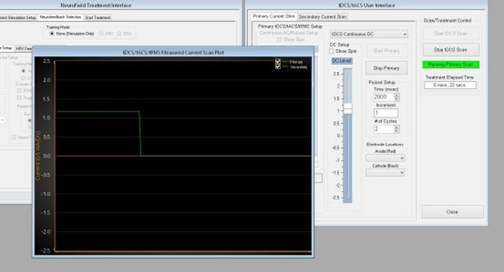
What is Transcranial Direct Current Stimulation (TDCS)?
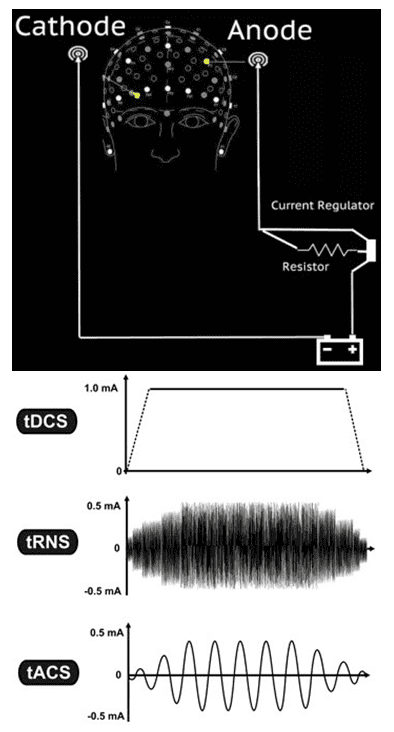
Transcranial Direct Current Stimulation is a form of electrical stimulation that is used to treat many conditions and pathologies, both in the brain and in the body. The technology uses a positive electrode and a negative electrode (called the anode and the cathode). Electrons are streamed from the anode to the cathode. This is distinct from Transcranial Alternating Current Stimulation, in which the roles of anode and cathode switch between the electrodes.
Learn More About Tacs
Direct current passes a one-way current through the brain or the body. In the brain, this causes a surge in calcium ions and in sodium ions. This causes neuroplasticity(1), which makes the brain more susceptible to neurofeedback and pEMF conditioning. It increases the potential of the brain to change, learn and grow.
- https://www.ncbi.nlm.nih.gov/pubmed/27000523 DOI:10.1038/ncomms11100
What is Transcranial Direct Current Stimulation useful for?
Direct Current:
- Increases blood flow to the targeted areas
- Causes large scale network
- Stimulates the area related to the anode
- Inhibits the area related to the cathode
- Causes calcium and sodium ion surges in the
Which conditions does Transcranial Direct Current Treat?
Migraines have been alleviated in our clinic by the application of TDCS. Our migraine protocol causes the underlying blood vessels to dilate. This allows oxygenation of the parietal and occipital cortices, which are related to the pain sensation and visual auras which people perceive during their migraine attacks.
TDCS is used to treat a whole gamut of conditions. Here is a link to a website which describes some of the protocols, as well as the scientific experimental evidence for why the treatment is designed precisely how it is.
The basics of tDCS:
 Credit: Soterix Medical
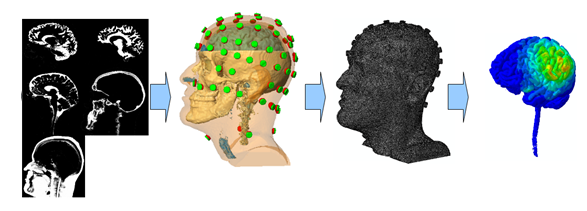
Transcranial Direct-Current Stimulation (tDCS) is a contemporary, portable, non-invasive neuro modulatory technique that delivers a low electric current to the scalp. A fixed current between 1 and 2 mA is typically applied. tDCS works by applying a positive (anodal) or negative (cathodal) current via electrodes to an area, facilitating the depolarization or hyperpolarization of neurons, respectively. The positioning of the anode and cathode electrodes is used to influence how current flows, and where in the brain it does. The current delivered by tDCS is not considered strong enough to trigger an action potential in a neuron; its sub-threshold effect works by bringing the neurons closer to, or farther from firing. Plainly, tDCS augments the resting voltage of the neuronal membrane to prod a neuron’s activity in a desired direction. In this way, tDCS may work by strengthening or weakening synaptic transmission between neurons by augmenting synaptic plasticity which is, in turn, the cellular basis of learning. tDCS is often combined with training. Training in itself produces learning (synaptic plasticity), and concurrent tDCS amplifies these effects (enhances synaptic plasticity). Some areas tDCS is currently being explored include: depression, schizophrenia, aphasia, addiction, epilepsy, chronic pain (migraine, fibromyalgia), attention, and motor rehabilitation.
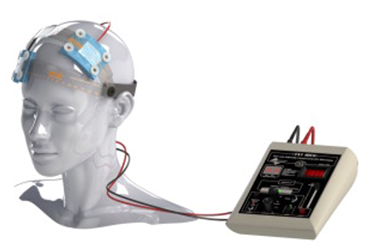
What does the tDCS device look like?
tDCS devices are small battery powered devices. There is usually a control panel that allows you to program the device (e.g., to set the duration and intensity of stimulation). Electrodes are placed on the head and held in place by headgear — usually an elastic strap. A cable connects each electrode to the stimulator. When the stimulator is turned on, current flows from the device to the electrode, and subsequently through the brain. Research and clinical grade stimulators have many features that help ensure stimulation is tolerable and reliable. This includes an impedance meter and a current meter.
 What does tDCS feel like? What are the side-effects?
 What does tDCS feel like? What are the side-effects?
Research on the side-effects of tDCS is ongoing, but so far the established side-effects are minor, and restricted to the electrode location. They include temporary skin redness, itching, and tingling. Other suggested side-effects of tDCS include headache, nausea, and dizziness. It should be noted that these latter three side-effects have been illustrated to occur at nearly the same rate as sham stimulation (fake stimulation).1 When tDCS is applied inadequately, other side-effects can occur such as a phosphene which is a temporary, non-dangerous flash of light. This can occur if electrodes are placed too close to the eye. Additionally, incorrect tDCS administration can elicit standard skin burns. There is no scientific evidence that demonstrates lasting injury or irreversible side-effects from tDCS. Nonetheless it should be noted that all of the tolerability and safety data on tDCS comes from controlled human trials using specialized equipment and strictly controlled protocols (e.g., limiting current duration, number of sessions).
What don’t we know about tDCS?
While questions remain about the best applications for tDCS, there are decades of research denoting its implicated mechanism. Recent work suggests glial activation and the alteration of intracellular cAMP and calcium concentrations to largely contribute to tDCS’s effects.2 It is also understood that the plasticity of the human brain can allow lasting excitability changes as a result of tDCS application, namely, long-term potentiation (LTP) and long-term depression (LTD).
 Credit: Halo Sport
References:
1Brunoni, A. R., Amadera, J., Berbel, B., Volz, M. S., Rizzerio, B. G., &Fregni, F. (2011). A systematic review on reporting and assessment of adverse effects associated with transcranial direct current stimulation. International Journal of Neuropsychopharmacology, 14(8), 1133-1145.
2Monai, H., Ohkura, M., Tanaka, M., Oe, Y., Konno, A., Hirai, H., … &Hirase, H. (2016). Calcium imaging reveals glial involvement in transcranial direct current stimulation-induced plasticity in mouse brain. Nature communications, 7.
What is Photobiomodulation?
Photobiomodulation therapy is defined as the utilization of non-ionizing electromagnetic energy to trigger photochemical changes within cellular structures that are receptive to photons. Mitochondria is particularly receptive to this process. At the cellular level, visible red and near infrared light (NIR) energy are absorbed by mitochondria, which perform the function of producing cellular energy called “ATP”. The key to this entire process is a mitochondrial enzyme called cytochrome oxidase c, a chromophore, which accepts photonic energy of specific wavelengths when functioning below par.
What is Photobiology?
Photobiology is the study of the effects of non-ionizing radiation on biological systems. The biological effect varies with the wavelength region of the radiation. The radiation is absorbed by molecules in skin such as DNA, protein or certain drugs. The molecules are changed chemically into products that initiate biochemical responses in the cells.
Biological reaction to light is nothing new, there are numerous examples of light induced photochemical reactions in biological systems. Vitamin D synthesis in our skin is an example of a photochemical reaction. The power density of sunlight is only 105 mW/cm2 yet when ultraviolet B (UVB) rays strikes our skin, it converts a universally present form of cholesterol, 7-dehydrocholesterol to vitamin D3. We normally experience this through our eyes which are obviously photosensitive. Our vision is based upon light hitting our retinas and creating a chemical reaction that allows us to see. Throughout the course of evolution, photons have played a vital role in photo-chemically energizing certain cells.
What are the Pathways of Photobiomodulation?
- NO (Nitric Oxide)
- ROS (Reactive Oxygen Series) → PKD (gene) → IkB (Inhibitor κB) + NF-κB (nuclear factor κB) → NF-κB (nuclear factor κB stimulates gene transcription)
- ATP (Adenosine Triphosphate) → cAMP (catabolite activator protein) → Jun/Fos (oncogenic transcription factors) → AP-1 (activator protein transcription factor stimulates gene transcription)
What are the Mechanisms of Photobiomodulation?
The current and widely accepted proposal is that low level visible red to near infrared light (NIR) energy is absorbed by mitochondria and converted into ATP for cellular use. In addition, the process creates mild oxidants (ROS), which leads to gene transcription and then to cellular repair and healing. The process also unclogs the chain that has been clogged by nitric oxide (NO).[1] The nitric oxide is then released back into the system. Nitric oxide is a molecule that our body produces to help its 50 trillion cells communicate with each other. This communication happens by transmission of signals throughout the entire body. Additionally, nitric oxide helps to dilate the blood vessels and improve blood circulation.
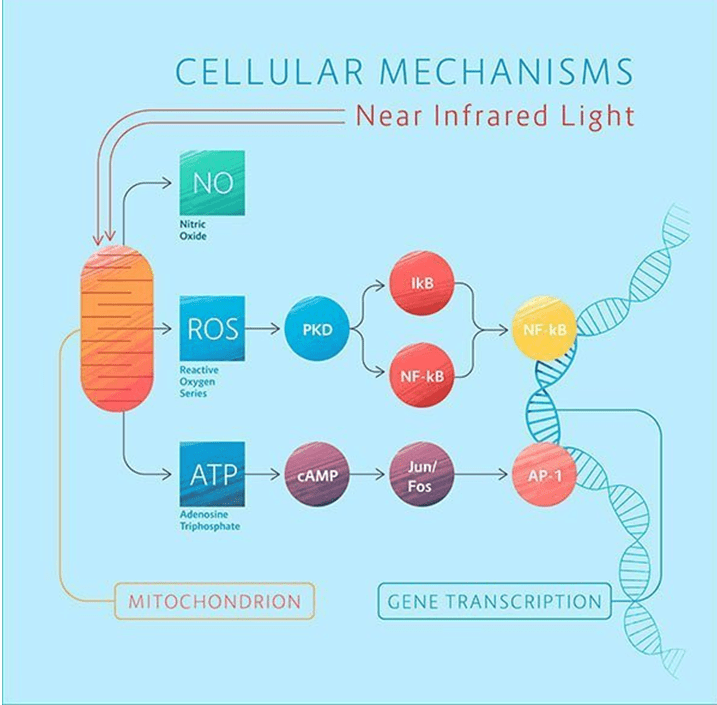
Ref: Original: “Basic Photomedicine”, Ying-Ying Huang, Pawel Mroz and Michael R. Hamblin, Harvard Medical School.
Current design: Vielight Inc.
Brain Photobiomodulation
“Low-energy photon irradiation in the near-IR spectral range with low-energy lasers or LEDs positively modulates various important biological processes in cell culture and animal models. Photobiomodulation is applied clinically in the treatment of soft tissue injuries and accelerated wound healing. The mechanism of brain photobiomodulation by red to near-IR light at the cellular level has been ascribed by research institutions to the activation of cellular mitochondrial respiratory chain components, resulting in a signaling cascade that promotes cellular proliferation and cytoprotection.
Research indicates that cytochrome c oxidase is a key photo-acceptor of irradiation in the far-red to near-IR spectral range. Cytochrome c oxidase is an integral membrane protein that contains multiple redox active metal centers. Additionally, it has a strong absorbency in the far-red to near-IR spectral range detectable in-vivo by near-IR spectroscopy.
Additionally, photobiomodulation increases the rate of electron transfer in purified cytochrome oxidase, increasing mitochondrial respiration and ATP synthesis in isolated mitochondria, and up-regulating cytochrome oxidase activity in cultured neuronal cells – leading to neuroprotective effects and neuronal function.
In addition to increased oxidative metabolism, red to near-IR light stimulation of mitochondrial electron transfer is known to increase the generation of reactive oxygen species (ROS). ROS functions as signaling molecules, providing communication between mitochondria and the nucleus.”[1]
[1] – Proc Natl Acad Sci U S A. 2003 Mar 18; 100(6): 3439–3444.
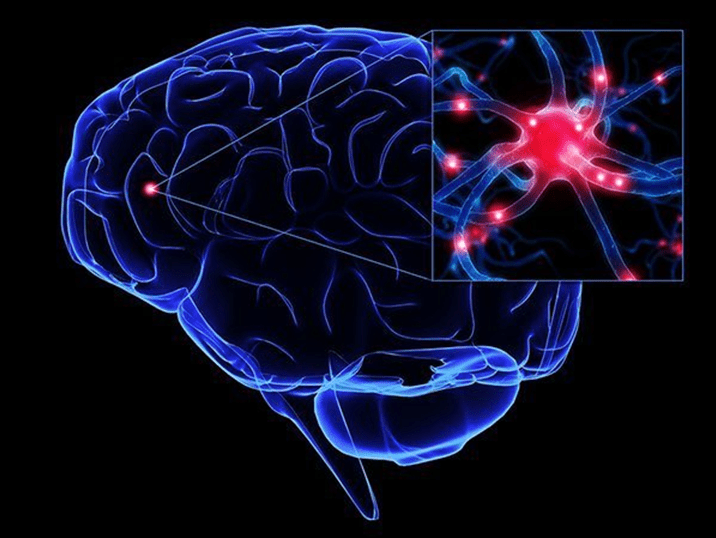
Brain Bioenergetics
Neurons contain mitochondria.
The process of utilizing the non-ionizing electromagnetic energy (light) to energize neuronal mitochondria triggers a cascade of beneficial cellular events.
Some potential effects are : neuroprotective effects, self-repair mechanisms and enhanced function.[1]
[1] : “Neurological and psychological applications of transcranial LEDs“, Department of Psychology and Institute for Neuroscience, University of Texas.